Originally published on February 4, 2011
By Ashiem Matthn
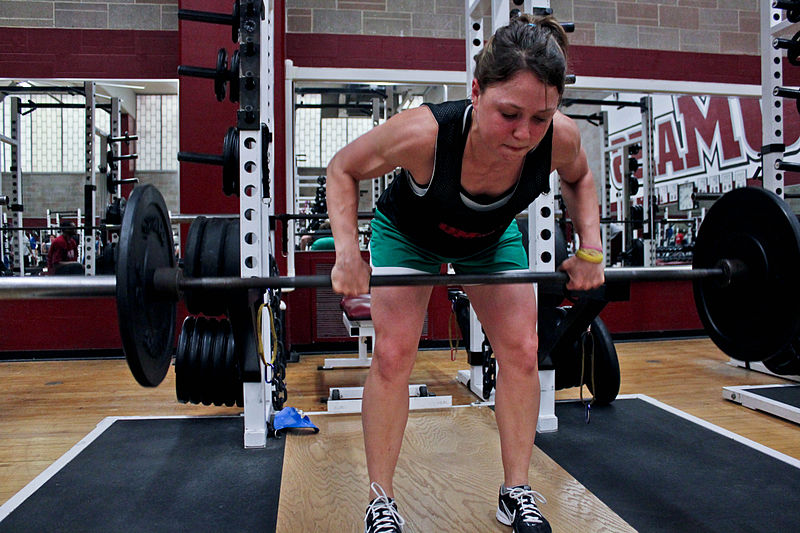
Deloaded Bent Over Barbell Rows are rows requiring the resistance (or weight) to be deloaded onto the floor after each repetition performed. Therefore, every repetition performed is done so from a dead stop and the bar is picked up off the floor or a raised platform (if required), unlike a regular bent over barbell row in which the bar remains suspended above the floor and tension is maintained in the body, shoulders, and arms.
Deloaded Rows target the middle and upper back and are a great supplementary row exercise and can be used as often as all other row variation such as Dumbbell Rows, regular Barbell Rows, Chest Supported Rows and Cable Rows and Resistance Band rows. Although this article focuses on deloaded rows with a barbell, dumbell rows can also be deloaded in a similar way.
Although less overall weight may be possible with a deloaded row, another advantage over regular free weight rows is that the back is unloaded between each rep. This forces a quick core contraction to stabilize the torso when the weight is hoisted plus rests the back so that the lumbar is not a limiting endurance factor. During regular bent over rows, the body is always required to support the weight and this puts a continuous static load on the lower back during the entire set. Therefore, it is possible for the lower back to fatigue to such a point that it limits your ability to perform more reps even though you normally could have if the load did not have to be continually supported. Cable rows have a similar advantage as deloaded rows in this regard, as well as chest supported rows.
Deloaded Rows are also referred to as deweighted rows or dead stop rows. The term “Pendlay Rows” and “JS Rows” have also been given to them in some internet circles but the Pendlay row or JS is purportedly a “dynamic row” and not simply a row from the floor or dead stop.
Training Equipment for Deloaded Bent Over Rows
The tools a trainee will need are:
- Barbell
- Weightlifting Plates
Some may also find a raised barbell platform of some kind to be necessary as the barbell may be too low when placed on the floor. We’ll go more into this later.

How to Perform the Deloaded Barbell Rows
- Walk up to the bar and take a slightly wider than shoulder width stance.
- Bend down and grab the barbell.
- Make sure your body-weight is centered on your hips.
- Tighten the back, abdominal, and gluteal muscles (as shown in the video) and make the upper body almost parallel to the floor
- Make sure the bar is close to the Trainee’s shins.
- Actively squeeze the bar.
- PULL!!!!
Video Demonstration of Deloaded Rows
Here is a video demonstration of Deloaded Barbell Rows from Platforms (the bar is elevated by platforms that the weight plates come to rest on):
Here is a video demonstration of Deloaded Rows from a Low Position:
Notes on the Steps listed above
Here are a series of steps to execute a proper Deloaded Row:
Setting the Upper Back and Rowing Correctly
The trainee must take a shoulder width stance or slightly narrower. The trainee must be able to maintain a proper tight back position throughout the movement. This is difficult because most individuals tend to round their backs inadvertently. The video above will better illustrate this point.
Stance Width, Bar Movement, and Hips
When pulling the barbell, the trainee should be able to “sit-back” onto his/her hips while maintaining the parallel angle of his/her torso to the floor. The bar must move straight up. If the trainee’s bodyweight is distributed to his/her hips (with the right stance), this will allow the bar to travel straight up and close to the body, therefore, creating stability. As the trainee progresses and heavier (relatively speaking) loads are being lifted, he/she will need to rely on this aspect to complete the repetition.
Using a Platform
Deloaded Rows, for most trainees, require the torso to be parallel, or close to parallel, to the floor. However, not all trainees are capable performing a barbell row with the bar on the floor. The torso may be forced below parallel and, indeed, it would be better for a slight upward angle, above parallel to be maintained. Feel free to place the barbell on a raised platform, at a suitable height, so the exercise can be done from a more comfortable position.
How to Progress on Deloaded Rows
The most effective way to improve on Deloaded Rows would be to start out at a base volume of 3-5 reps for 2-3 sets. The Trainee must build on this using the principles outlined in Eric’s Single Double Triple Progression article and summarized by me in the SDT FAQ.
A great way to gradually add weight to the bar by actually adding weight to the bar and not just relying on adding reps and sets is to use micro-loading fractional plates.
Conclusion
Deloaded Rows are a great exercise to build rowing strength and should be used in the same manner as other Row variations such as Dumbbell Rows, regular Barbell Rows, Chest Supported Rows and Cable Rows.